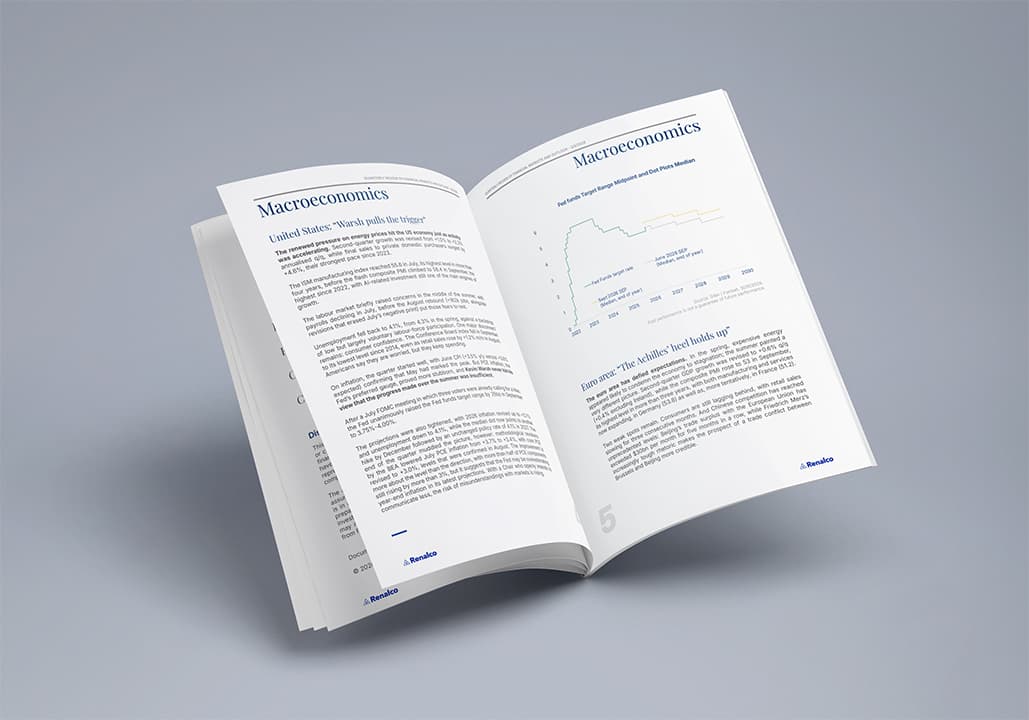

The very first Renalco quarterly review, in cooperation with Kepler Cheuvreux Solutions, is now available.
We are delighted to share our first quarterly review with a look back at the highlights of 2023, our outlook for 2024, as well as our views regarding various asset classes. Finally, we thought it would be appropriate to share a spotlight on Swiss stocks that we hope you will find interesting.
Look Back at 2023 Highlights
- Geopolitical events in Ukraine, as well as Sino-American tensions, increase uncertainty level ("Balloon-gate").
- The AI theme is omnipresent, OpenAI launches GPT-4.
- China abandons its Zero Covid policy and Xi Jinping is re-elected.
- India becomes the most populated country in the world, overtaking China.
- LVMH becomes the first European company to reach a stock market value of $500 billion.
- The Japanese stock market crosses the 30,000 point mark last reached in 1990.
- UBS buys Credit Suisse.
- The Israel/Hamas war: a Hamas attack from the Gaza Strip.
- The planet is warming: the months of June to October were the hottest on record.
- Interest rates are at a historical high, the yield on 10-year US Treasury bonds reaches 5% for the first time since 2007.
- The “magnificent 7” (Alphabet, Amazon, Apple, Meta, Microsoft, Nvidia and Tesla) represent 50% of the NASDAQ capitalisation and largest part of the rise in the S&P 500.
- Gold reaches an all-time high.
- The Swiss franc reaches a historic record rate against the euro.
2024 Outlook
- Deflation continues. The peak observed in monetary tightening has been reached. That said, market expectations regarding the timing and magnitude of rate cuts seemed excessive.
- Appetite for risk has slightly declined after reaching a very high level in mid-December. It is currently at slightly elevated levels signaling moderate caution in the near term.
- Long-term interest rates are following a downward trend despite some ups and downs in inflation, especially in the USA. Asset markets remain stimulated by the idea of a 'soft landing' scenario favoured by average macroeconomic dynamics and lower inflation, allowing a more accommodating tone from central banks. In the absence of a change in momentum, the 'soft landing' theme should prevail which is favourable for stocks. However, in practice, this is already partially taken into account with a certain appetite for risk.
- In China, about $5 trillion of market value has been wiped from onshore stocks since their peak in 2021, driving an urgent need for policymakers to do more.
- 2024 will mark the largest number of elections in the world. About 50% of the world's population will go to the polls representing 43% of global GDP.
- The evolution of geopolitics remains crucial with a continuation of conflicts in Ukraine and the Middle East and a risk of expansion.
Our View on Asset Classes
View |
|
|
|
|
|---|---|---|---|---|
Liquidity |
||||
|
Liquidity |
|
||
Bonds |
||||
|
CHF |
|
||
|
EURO |
|
||
|
USD |
|
||
|
Emerging Markets |
|
||
Shares |
||||
|
Switzerland |
|
||
|
Euro-Zone |
|
||
|
Rest of Europe |
|
||
|
USA |
|
||
|
Japan |
|
||
|
Asia ex-Japan |
|
||
|
Emerging Markets |
|
||
Commodities |
||||
|
Gold |
|
||
|
Energy |
|
||
Currency : CHF |
||||
|
EUR |
|
||
|
USD |
|
||















Highlight: Swiss Shares
- The SMI has underperformed other indices over the past two years and is still below end of 2021 levels. The strength of the Swiss Franc has been a key element, driven higher by the SNB in its desire to fight against imported inflation via an appreciation of the exchange rate.
- At present, and while inflation in Switzerland is already well below 2%, the SNB is starting to be concerned by the impact of the strong Franc on industry and exports. Following the failure of the SNB's attempt to establish a monetary cap versus the euro options appear increasingly limited. A strong Swiss Franc could therefore be here to stay.
- However, we take note of the fact that the SNB can reduce its interest rates at any moment, with recent signs pointing to a possible change of direction in Swiss monetary policy. Companies with significant exposure to currency fluctuations could therefore benefit from an unexpected drop in interest rates that could lead to a sudden weakening of the Swiss Franc.
This shall allow exporting companies, which are the majority of the index, to better perform on the stock market. We are positive on the SMI given its defensive properties, specfically in a slowing European economic environment.