Muddying the waters
While we have turned less aggressive on risky assets during the summer due to the cooling job market in the US, data releases are sending mixed signals. Job creation has vanished, but consumers continue to spend, according to the latest numbers released by the BEA last week. And if consumers keep spending going forward, economic activity should stay resilient. Corporate profits may then reach new highs and outpace analyst expectations, fueling the flames of the equity market rally. In that regard, the Q3 earnings season that will start next week has seen analysts revising up earnings growth expectations for the S&P 500 (from 7.3% yoy at the end of June to 7.9% at present).
- The third estimate of Q2 real GDP points to a much stronger growth pace than expected (at 3.8% - qoq annualised - versus 2.6% expected initially). The consensus of economists still expects a marked deceleration heading into year-end. But nothing is less certain. The Fed Atlanta GDPNow estimate suggests the US economy is on track to grow at 3.9% in Q3!
- The recently released CFO survey that we show in the report sheds light on the broader picture. There is rising evidence that corporations have been absorbing Trump’s trade tariffs, thus sparing consumers. But companies are facing cost pressures and report that they are reining in spending plans and hiring plans. This helps towards reconciling the unusual pattern of weak job creation and strong consumer spending. How long this delicate equilibrium will last remains speculative.
- Our base case remains that with current valuations and downside macro risks, there is little incentive to chase the equity market rally. In our global asset allocation framework, we continue to advocate for geographical diversification in equities beyond US/ European markets (Overweight Japan & China, though we stay slight Overweight US equities) and for some diversification beyond equities (gold, bond duration).
The nuclear revival in the age of AI
With macro risks constraining risk appetite, we have launched several new thematics in recent quarters that have a common approach: getting exposure to themes where there is visibility for the medium term and strong policy support. Along those lines and with the support of our equity analysts, we built an equity basket to leverage the German stimulus package, the European sovereignty initiative, and the upside risk of conflict resolution between Ukraine and Russia. This week, we dig into the nuclear theme revival.
- Policy support for nuclear energy is strengthening in many countries. In the United States, the Inflation Reduction Act extended clean energy tax incentives to nuclear energy, drastically improving the economics of all operating reactors. In Europe, the EU taxonomy classified nuclear energy as a transition technology, recognising it as imperfect yet acceptable for several decades. Japan, home of the latest nuclear accident, decided at the beginning of 2023 to reopen most of the reactors that it had closed after the Fukushima accident in 2011 and to extend the useful life of its fleet from 40 to 60 years.
- The two major drivers of the nuclear revival are AI and sustainability. While data centers are needed to train and deploy AI models, Gen AI development requires more and more electricity. Several influential US tech companies have been signing deals with nuclear players or start-ups to gain access to reliable electricity for their hungry data centres around the clock. Concurrently, meeting net zero targets will require more and cleaner power for many activities: green buildings, clean transportation, digitalization... In terms of CO2 emissions, nuclear is one of the cleanest sources of electricity production (12g/kWh). Convinced by the key role nuclear energy should have in meeting net zero targets, more than 20 countries agreed to triple nuclear energy capacity by 2050.
- Small Modular Reactors (SMRs) are poised to become the backbone of AI infrastructure. Small modular reactors (SMRs) are advanced nuclear reactors that have a power capacity of up to 300 MW(e) per unit, which is about one-third of the generating capacity of traditional nuclear power reactors. They are poised to become the backbone of AI infrastructure, with tech giants committing over $10 billion to nuclear partnerships and 22 gigawatts of projects in development globally.
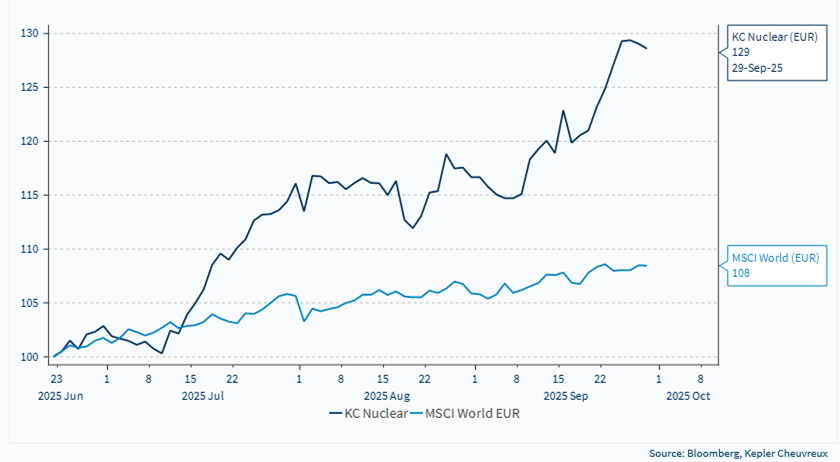
- Flows and performance. Based on our Trackinsight database, we show in the report the massive inflows into nuclear ETFs. Meanwhile, performance is meeting expectations. Since the launch of our thematic a quarter ago, our strategy is up by almost 30% (in euros) versus +8% for the MSCI World (in euros).
Week Ahead
In the US, the ISM manufacturing business survey and the job market report will be available for September. In Europe, the September CPI inflation will be released. In Japan, the Tankan survey will shed light on recent business dynamics.
Performance of the KC Solutions Nuclear Revival basket (9 stocks, equal-weight, started 20/06/25)