In recent weeks, markets have been driven by significant back-and-forth on the likelihood of a deal between the US and Iran. As we go to press, the probability of an agreement has increased, oil prices have eased, and this is supporting equities, bonds, and gold. Yet, as recently as a week ago, markets were focused on the risk of a no-deal scenario, pushing inflation expectations and bond yields higher while weighing on equities. Investors remain caught in this binary market framework.
Reaching an agreement remains challenging. Iran has recently regained bargaining power and is offering no major concessions following the US blockade of Iranian ports. At the same time, Trump appears somewhat weakened, facing growing resistance from Republican hardliners who oppose any deal that would preserve the current Iranian regime or fail to adequately address its nuclear ambitions. As highlighted in our report, public dissatisfaction is also rising, with Trump’s approval ratings declining further.
Despite these uncertainties, implied US equity volatility remains near or even below pre-conflict levels, reflecting optimism that the US economy has unlocked new sources of growth, particularly through AI-related infrastructure investment. The economic outlook is more challenging in Europe, where preliminary May PMIs point to a marked slowdown in activity. However, economic fundamentals and market performance can diverge, especially in Europe, where companies generate a substantial share of revenues abroad. In this context, cyclical European sectors may continue to outperform, with themes such as tech, metals & mining, banks, and capital goods leading since the end of March, supported by a much stronger-than-expected earnings season.
We tactically adopted a more cautious stance for three main reasons. First, the longer it takes to reach a deal, the more prolonged the disruption in oil markets is likely to be. We expect this to increasingly weigh on consumer spending, with upcoming data, particularly US consumer confidence and April personal spending, likely to show signs of weakening. Second, following the rebound in risk assets since late March, expected returns have diminished. With the earnings season now behind us and corporate newsflow fading, markets may increasingly focus on the macroeconomic challenges posed by energy disruptions and the resulting pressure on household purchasing power. Third, any deal remains uncertain given Iran’s unwillingness to concede on enriched uranium (Latest news points to an agreement on free Hormuz passage).
Our cautious stance, adopted last week, resulted in a reduction of our equity allocation in favour of cash. We clearly signalled that this move was a tactical de-risking, with no intention of maintaining elevated cash levels for an extended period.
As news flow around energy risks has improved, we are now redeploying this cash into i) euro area equities (+5), which have shown the strongest negative correlation to oil prices among regional equity markets. ii) We are also increasing our exposure to gold (+5), which remains highly correlated to oil prices, and, iii) to UK gilts, which experienced a recent drawdown amid political turmoil that now appears to have subsided. Overall, these adjustments result in a move to a slight overweight in equities (from neutral), alongside increased duration exposure through government bonds and gold. The latter provides a hedge against a potential further slowdown in economic activity. We maintain a 5% cash position, awaiting greater visibility on US–Iran negotiations.
Thematics: European sovereignty and digitalization. Digital autonomy was identified in the Draghi report as a critical area for managing dependencies and vulnerabilities. As we highlight in the report, Amazon, Microsoft, and Google accounted for more than 70% of the European cloud market at the end of 2025. This represents a key source of vulnerability, particularly as the transatlantic relationship has become more uncertain and less predictable under Trump.
- To address these vulnerabilities, the European Commission awarded last month a €180 million tender to four predominantly European cloud providers to strengthen the EU’s digital sovereignty and reduce reliance on non-European technologies. Selected companies must meet strict sovereignty criteria covering security, legal control, and supply-chain transparency, while ensuring limited influence from non-EU actors. One month after this announcement, the European Commission is now considering restricting the use of U.S. cloud providers for sensitive government data as part of a broader “Tech Sovereignty Package”. The proposal would not fully exclude foreign providers but could limit their role in critical sectors such as health, finance, and justice.
- In parallel, several major French companies, including Orange, Capgemini, EDF, and Iliad, have formed the AION consortium to bid for a European AI “gigafactory” under an EU-sponsored programme. The project aims to develop a large-scale, sovereign computing infrastructure by leveraging expertise across the AI value chain.
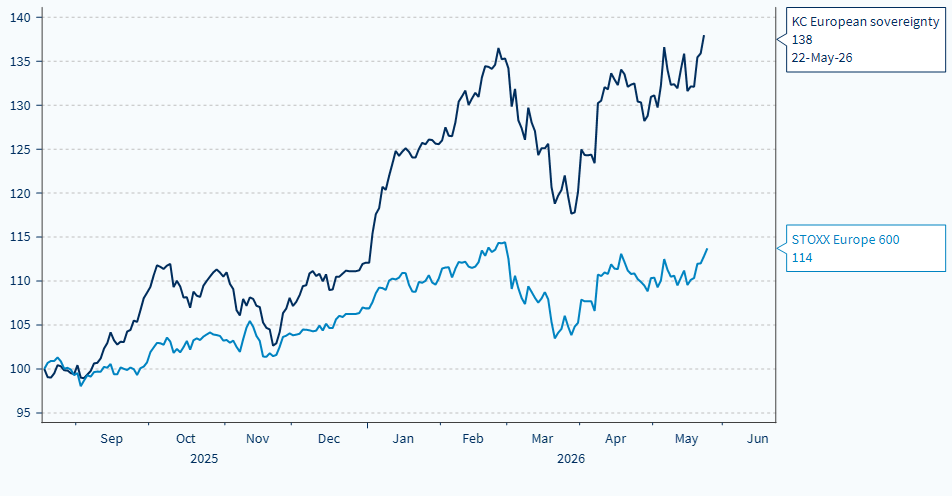
- Our European sovereignty strategy, composed of 15 stocks across sectors that are receiving this policy support, is delivering on its promises in terms of performance, up 38% since its launch in August 2025.
Performance of the KC Solutions European sovereignty basket (15 stocks, equal-weight, started 18/08/25)