
As renewed geopolitical tensions fuel inflation concerns while the technology, infrastructure and defence supercycle sustains robust earnings growth, markets are approaching a critical inflection point. With the earnings season now underway and summer liquidity conditions thinning, the balance between geopolitical risks and corporate earnings could trigger significant market moves in either direction. In this weekly note, we examine these complex market dynamics and present the trade ideas that we believe are best positioned to capitalize on them.
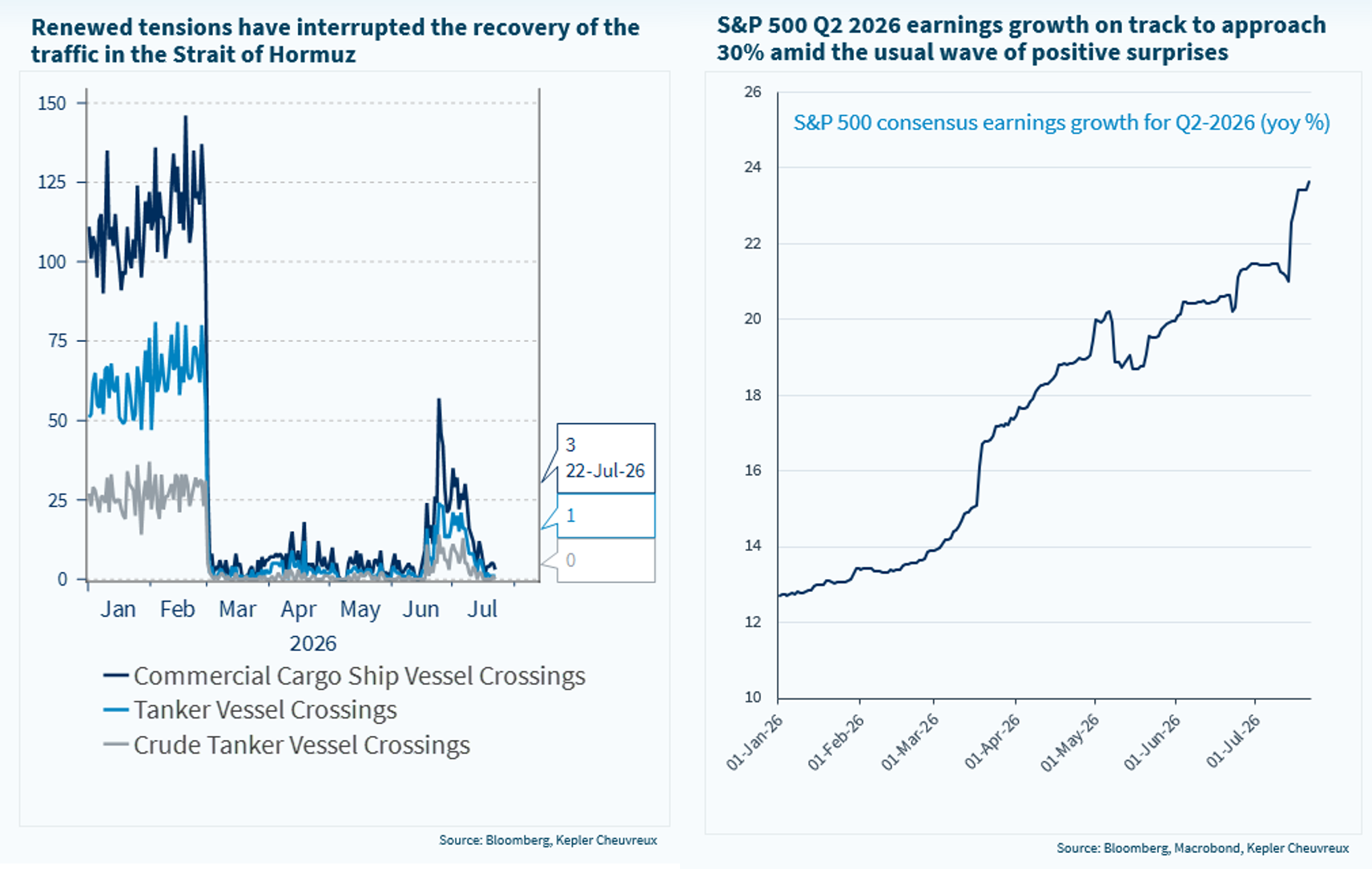
The geopolitical backdrop remains particularly challenging. In our view, Iran is seeking to exploit the political constraints imposed by the US midterm election cycle to strengthen its grip on the Strait of Hormuz, betting that President Trump will be reluctant to risk another surge in oil prices. As we go to press, Brent crude is trading above $90/bbl, despite reports that diplomatic efforts are underway to defuse tensions and prevent further escalation.
From an investment perspective, this environment is particularly difficult to position for. Geopolitical tensions are raising stagflation risks, undermining the outlook for both equities and bonds. As a result, reducing portfolio risk through higher bond exposure is not an especially attractive option while inflation expectations continue to move higher. Meanwhile, geopolitical risks can fade as quickly as they emerge, leaving long crude oil positions exposed to a sudden correction.
Overall, equities remain the more attractive asset class in an environment characterised by moderately higher inflation and resilient economic growth.
The main support for equities, however, remains the continued improvement in corporate earnings expectations. According to Factset (link), a record number of S&P 500 technology companies have issued positive EPS guidance for Q2. Against this backdrop, S&P 500 earnings growth could approach 30% year-over-year in Q2 2026. While consensus currently expects around 25% EPS growth, the usual pattern of positive earnings surprises could lift that figure closer to 30%. In Europe, consensus forecasts point to EPS growth of 15-17%, led primarily by the energy, materials and technology sectors.
While the earnings season is still in its early stages, with only 68 S&P 500 constituents (14%) having reported quarterly earnings so far, the aggregate earnings surprise exceeds 15%. As a result, year-over-year earnings growth for these companies has surged to 45%. Against this backdrop, it is difficult to make a compelling case for betting against US large-cap equities, unless one assumes that oil prices will climb back toward $120/bbl in the coming weeks.
In Europe, 83 STOXX Europe 600 constituents, representing 16% of the companies expected to report earnings this season, have released quarterly results so far. While the aggregate earnings surprise is more modest at around 3%, according to Bloomberg, earnings growth remains robust at 37% year-over-year for these companies. Financials continue to stand out, benefiting from strong earnings momentum and an exceptionally active M&A environment. In that regard, our analysts have published a dedicated report on the surge in European M&A activity, highlighting the sectors attracting the most deal flow and the trade ideas best placed to benefit.
Cross-asset Strategy: We retain a cautious bias, as geopolitical risks may get worse before they get better. However, the renewed tensions in the Strait of Hormuz are generating progressively less disruption across financial markets. With a strong earnings season now underway, we do not believe the current environment warrants a reduction in risk exposure. In addition, safe-haven alternatives remain relatively unattractive, as higher energy prices could lift inflation expectations and weigh on bond markets. We therefore maintain an Overweight stance on equities, with exposure to the Technology theme through the Nasdaq and Emerging Markets (ex-China), while preserving diversification through allocations to the euro area and U.S. small caps, whose performance is less dependent on technology stocks.
European equities: As the euro area remains vulnerable to geopolitical developments due to its reliance on energy imports, a degree of caution is warranted when positioning sector exposure. At this stage, we favour defensive sectors such as pharmaceuticals, telecommunications and utilities. In this report, we also draw on our analysts' work on the ongoing wave of European M&A activity (see The European Consolidation Puzzle), which continues to be particularly strong in the technology and financial sectors.
Regarding financials, the tables may well have turned for bank consolidation in Europe as UniCredit is getting very close to gaining control of Commerzbank. UniCredit’s example shows that persistence, bold management action, and flawless execution can overcome political hostility, inflexible regulatory and supervisory frameworks. Our analysts examine in detail the possible permutations among the Top 20 market caps in the sector. As a direct consequence, they upgraded Quilter, Société Générale, and Unicaja from Hold to Buy.
CHART OF THE WEEK
Geopolitical Risks Persist, but Strong Earnings and Surging European M&A Support Equities