
Our report's title echoes the situation in France, which we revisit this week. It comes amid such nervousness in the bond markets that signs of stress reminiscent of the 2011-2012 sovereign debt crisis have reappeared. But in a deliberate attempt to downplay the drama, our title also refers to Bob Dylan's masterpiece, released fifty years ago, which evokes rupture, transition and renewal. At a time of high anxiety, especially in France, this parallel is meant to remind our readers that even when there is blood in the streets, the best can emerge from the worst.
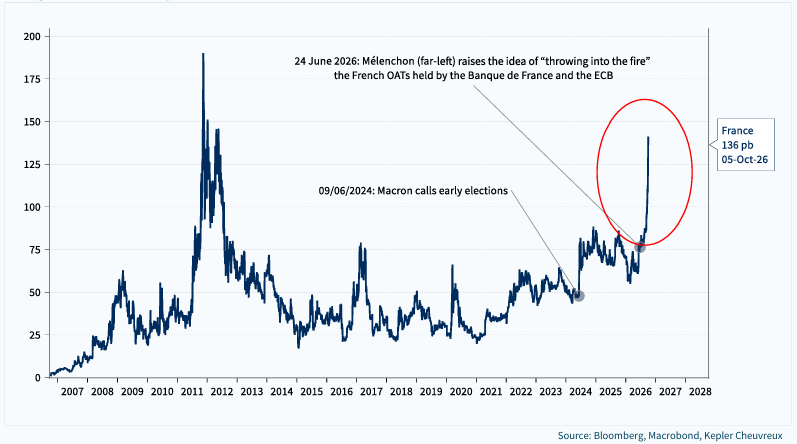
During September, the OAT-Bund spread, which measures the risk premium between the two sovereign issuers, exploded to problematic levels. This yield differential had stepped up from summer 2024, with the dissolution of the National Assembly and the political deadlock. Until recently, the 10-year OAT yield stood between 65 and 85 basis points (bps) above Germany's. But since the far-left candidate Jean-Luc Mélenchon came up with the brilliant idea of cancelling the debt held by the Banque de France and the ECB, markets have caught fire. Over the course of September, the spread widened exponentially and now stands at around 140 bps.
3 risk scenarios :
#1 (adverse scenario): With political cacophony persisting, members of Parliament might fail to agree on the first test, the 2027 budget. A budget would still be passed, either by adopting the text without a vote by deputies (i.e. Article 49.3 of the Constitution, which seems the most likely), or by implementing the budget by ordinance, which has never been tested under the 5th Republic, or by extending the previous finance law. But the political climate would keep markets on alert.
The very negative signal sent ahead of the presidential election would put additional upward pressure on the OAT-Bund spread (up to 250-350 bps). In the draft finance bill presented in early October, the State's projected financing requirement for 2027 amounts to €339.7 billion and would be covered by medium- and long-term debt issuance.
But in an extreme situation, France could no longer finance itself on the markets and would face three choices: i) drastically reduce deficits, but going from a 5.4% deficit in 2026 to 0% in 2027 is impossible; ii) ask for help from the IMF/European Commission/ECB, which would place the country under tutelage, i.e. a forced-march reform programme in order to obtain disbursements under an adjustment programme negotiated with the lenders; iii) default, which has not happened since the end of the 18th century and would cause enormous shockwaves on global markets, and even call the euro into question. In this scenario, the 10-year OAT yield rises to 7-8%, but there is no longer a market at those yield levels.
The ECB could activate the OMT (Outright Monetary Transactions) programme, never used since Mario Draghi's famous "Whatever It Takes“ in July 2012. It consists of ECB purchases of debt securities issued by countries in difficulty. However, OMT would be implemented in exchange for reforms and requires a state to request assistance from the European Stability Mechanism, which carries a strong stigma.
The TPI (Transmission Protection Instrument) was set up by the ECB in 2022. It aims to ensure smooth transmission of monetary policy, but a precondition is compliance with the European fiscal framework. Purchase volumes are unlimited and calibrated to the severity of the risks. The TPI offers more flexibility than the OMT and allows rapid intervention on maturities of 1 to 10 years, whereas the OMT targets only maturities of 1 to 3 years.
Probability of this scenario: 10-15% in our view.
#2 (intermediate scenario): Pressure from financial markets forces parliamentarians to give way, and they approve a 2027 budget that is relatively ambitious in terms of fiscal balance, with a credible path back to a 3% deficit by 2029.
In this scenario, market pressure remains strong through the autumn because of execution risk, meaning the OAT-Bund spread holds at around 100 bps. Political antagonisms are temporarily set aside, which is no easy task ahead of a presidential campaign. Markets remain somewhat sceptical.
In this intermediate scenario, the ECB could also reassure markets by stabilizing the size of its balance sheet and temporarily halting Quantitative Tightening. This seems very plausible to us and would avoid sending a very negative signal about France, since the ECB would simply reinvest the debt reaching maturity across all issuers. We consider this likely in the short term.
Probability of this scenario: 55-60% in our view.
#3 (optimistic scenario): Citizens' anxiety about deficits and public debt generates momentum in the polls for a moderate, reform-minded candidate (Édouard Philippe / Gabriel Attal / Bruno Retailleau / David Lisnard), who reassures markets.
Bond tensions ease, and the yield differential with Germany reverts toward 80-100 bps. It is interesting to note that Édouard Philippe (centrist) is rising in the polls after proposing to raise the retirement age and the number of contribution years. Markets would nevertheless still demand a risk premium given social tensions and the execution risk of reforms. Some readers will find this scenario unrealistic. We nonetheless believe the probability is higher than it appears. The political capital invested in the eurozone should not be underestimated; it led to Mario Draghi's "whatever it takes" in 2012.
Probability of this scenario: 25-30% in our view.
What options does the ECB have as lender of last resort?
In the scenarios above, the ECB has a role to play as guarantor of the euro's stability.
As a first step, we think it is highly likely that the ECB will halt its Quantitative Tightening programme and reinvest the bonds maturing in its portfolio, across all issuers. This would avoid stigmatizing the most fragile countries.
Next, the ECB could activate various programmes, but the most convincing would be the TPI, created in 2022, which offers a great deal of latitude (eligible maturities range from 1 to 10 years). One of the preconditions, namely compliance with the EU fiscal framework (no excessive deficit procedure open and no failure to follow recommendations), could pose a problem for OAT purchases, but the recommendations-compliance aspect could nonetheless give the ECB some flexibility.
CHART OF THE WEEK
10-year OAT-Bund spread reaches levels unseen since the worst of the eurozone debt crisis in 2011-12