
Back to square one. While there were some positive signals last week regarding a potential reopening of the Strait of Hormuz, expectations rapidly turned sour. Maritime traffic in the Middle East remains deadlocked, and energy prices keep climbing. Time is becoming a headwind, as it increases the probability of second-round effects from energy prices feeding through to core inflation. The key downside risk is that an exogenous energy shock becomes endogenous, forcing central banks to tighten policy further. A wage-price spiral still looks unlikely to us, but markets rightly need to hedge against the risk that energy prices will stay higher for longer.
A month to forget. Fixed-income investors have witnessed a sharp rise in bond yields across maturities throughout September. The short end of both the USD and EUR curves has climbed faster than the long end, leading to a flattening of yield curves both on the 2s10s and the 10s30s segments. However, despite the adverse news flow, we show in this report that implied rate volatility remains well below the levels seen in 2022-23, when the Russia-Ukraine energy shock compounded the post-pandemic demand shock.
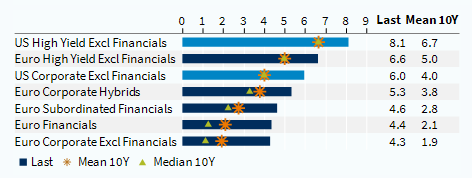
Medium-term rate expectations remain highly exposed to geopolitical risks and commodity price dynamics. Positioning for rate normalization, therefore, amounts to a bet on conflict de-escalation. We do not expect an immediate resolution, and we fear that nothing will happen before the US midterm elections. Yet, from a risk-reward perspective, bond yields are well above the levels observed in recent years, creating attractive medium-term opportunities, especially for IG credit. We added to short-term bonds in our asset allocation earlier in September, and we stay cautious for now on bond duration.
The bulk of the rise in Treasury yields since the start of the conflict is not related to inflation expectations, however. Consumer surveys and market-based instruments show that short-term and long-term inflation expectations are anchored. We estimate that the 126 bp rise in 10-year Treasury yields since 28 February, when the conflict with Iran began, is primarily attributable to a 106 bp increase in real short-term rates, while the 10-year term premium and the 10-year USD inflation swap contributed only 13 bp and 7 bp, respectively. The rise in real short-term rates expresses the fact that markets now expect the Fed to hold policy rates significantly above inflation to deal with ongoing uncertainty and bring inflation back to target.
Monetary policy uncertainty under the new Fed Chair, Kevin Warsh, together with resilient growth conditions, helps explain a significant share of the upward move in rates. Preliminary PMIs for September released last week were significantly above consensus expectations in the US and the euro area, at 58.4 for the US composite PMI (versus 55.3 expected) and 53.1 in the euro area (versus 51.7 expected).
Miscellaneous factors potentially weighing on yields. With regard to foreign demand for US Treasuries, China actually continues to rotate out of US Treasuries and into gold, but global investors remain buyers of Treasuries. Moreover, fiscal concerns do not appear to be driving the rise in bond yields, as CDS spreads do not show any sovereign credit tensions in the US or in most European countries. France and Italy are nonetheless facing sovereign credit concerns, but they appear as outliers. Political risk in France has been an issue since June 2024, on the back of a deeply fragmented Parliament, while Italy appears to be facing contagion effects from France.
On a positive note, Germany’s business prospects kept improving despite the energy price rise. The stimulus plan approved last year appears to be bearing fruit, as economists have significantly revised upward their growth estimates for H2 2026. The consensus is nonetheless still reluctant to extend positive revisions into 2027. Capturing this positive growth momentum through the DAX or the MDAX is not straightforward, as global constituents in the automotive and software sectors are only loosely linked to domestic economic conditions. Instead, our German stimulus basket, launched in 2025, focuses on industrials, materials and selected financials and, in our view, provides a much cleaner expression of domestic economic conditions.
CHART OF THE WEEK
Although spreads are tight, the yield to worst of IG credits in euros trades 250-320 bps above the 10Y average/median