
Amid renewed uncertainty in commodity markets after the deadly attacks on the Riyadh airport this weekend, crude oil is fairly stable and refined products are slightly down as we go to press. Despite lingering uncertainties, we see several fixed-income and credit segments offering attractive risk-reward opportunities following the recent selloff. We dig into four main ideas below:
#1: The yield on euro investment-grade credit (excluding financials) is close to its highest level since 2023, at around 4.2%, while both inflation and central banks are highly unlikely to revisit the extremes seen in 2022–23.
#2: We find UK Gilts attractive. The 10-year yield stands at approximately 5.4%, the government remains mindful of avoiding a repeat of the Liz Truss episode, and the Bank of England has been adjusting its quantitative tightening programme to mitigate upward pressure on bond yields. Closer ties with the EU under the new PM Burnham are also a positive.
#3: We slightly increased our allocation to Italian BTPs last week, on the back of fiscal credentials that are expected to stay supportive within the Euro Area. Meanwhile, we left our existing 10% position in UK Gilts unchanged. We are long GBPEUR in this trade.
#4: Beyond Europe, Flávio Bolsonaro is expected to secure a decisive victory in Brazil's runoff election on 25 October. Meanwhile, the yield on a 10-year USD-denominated Brazilian sovereign bond is trading close to 7%. We also favour gaining exposure to the Brazilian real (BRL) through local equities, an approach that we partially implemented last week by increasing our allocation to EM equities excluding China.
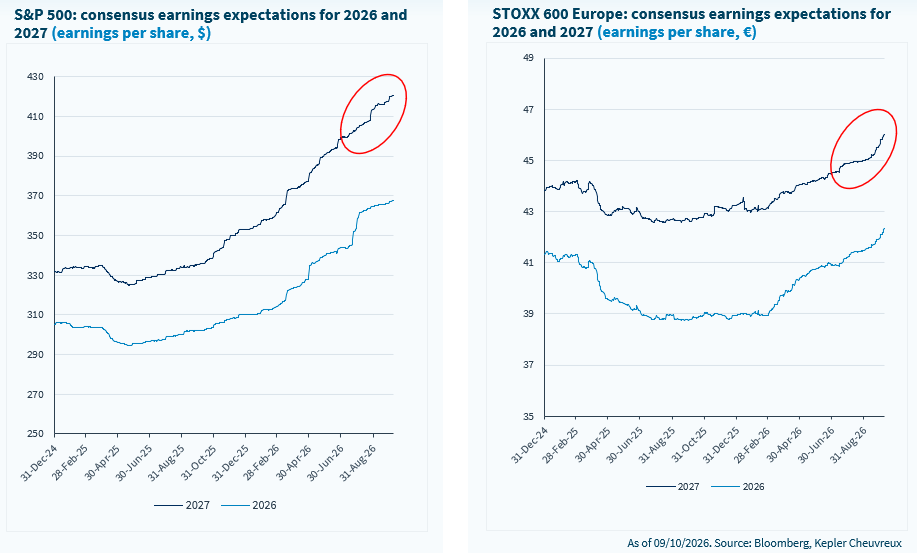
Get ready for earnings season. The corporate earnings season is about to begin in earnest. Expectations are high, yet companies may once again deliver results that exceed forecasts. The current regime of double-digit earnings growth is likely to persist over the coming quarters, with S&P 500 earnings per share expected to grow by 30% year-on-year in Q3, while the Stoxx Europe 600 is not far behind at 21%. Against a geopolitical backdrop that remains complex and challenging, the corporate earnings outlook continues to provide a meaningful source of support for risk assets.
At the sector level, Energy, Technology, and Industrials/Materials are expected to deliver double-digit EPS growth on both sides of the Atlantic. One notable distinction is the US Financial sector, where earnings growth is expected to be more subdued at just 3%. As a result, the upcoming results from major US banks will be closely scrutinised for signs of positive earnings surprises and a stronger underlying trend than currently anticipated.
European Consumer Cyclicals. In Europe, consumer cyclical companies are expected to deliver more than 20% EPS growth. We have remained cautious on the sector due to the erosion of consumers’ purchasing power caused by higher commodity prices. While we continue to approach consumer-related themes with caution, the upcoming earnings season could provide an opportunity to reassess our view should earnings prove more resilient than expected.
Basic Materials. As highlighted in this report, most sectors have experienced significant rotations over recent quarters. While these swings have been closely tied to volatility in commodity markets, with Brent crude rising 95% in Q1, falling 38% in Q2, and rebounding 42% in Q3, the Basic Materials sector has stood out for its resilience. Moreover, it has emerged as one of Europe's key beneficiaries of the AI investment cycle, a trend that continues to gain momentum. The sector also offers exposure to several long-term structural themes, including electrification, artificial intelligence, the energy transition, and infrastructure investment. Despite its strong performance, Materials sector valuations remain reasonable, suggesting further upside potential without excessive valuation risk.
CHART OF THE WEEK