
US midterms: two opposing forces for markets. The Democrats’ landslide victory at the US midterms caused wide gyrations across AI infrastructure stocks last week. But it also comes with positive spillovers, as markets are reassessing the risk of conflict escalation in the Middle East. After the dramatic rise in energy prices in Q3, we believe there is ample room for a pullback, which started to materialise in crude oil prices last week. We currently expect Brent at USD75/bbl for 2027 and USD70/bbl for 2028, but this is subject to revisions depending on the outcome of US-Iran negotiations (link).
Three investment ideas to play a normalisation in commodity prices:
As an important energy importer, Europe is well positioned to benefit from a pullback in commodity prices. Meanwhile, bond yields have ample room to normalise lower. In European fixed income, we keep preferring BTPs to OATs, though we have recently seen a significant decline in OAT yields for the first time in weeks. In France, social tensions appear to be decreasing, but the election-related uncertainty will persist during the next six months.
Lower commodity prices and bond yields are also set to support a rebound in gold, whose correlation with Brent currently stands at multi-decade lows. The PBOC continues to buy gold rather aggressively, a positive development.
In FX, there is room for a rebound in the EURUSD towards our year-end target of 1.15, as euro area-related sovereign debt concerns are easing and the Fed could become less hawkish more quickly if energy prices retreat. Klaas Knot, one of the leading contenders to become the next ECB president, has expressed a willingness to act decisively in a debt crisis. It is an important step forward towards restoring confidence in the euro. According to CFTC data on non-commercial positions, long positioning in the DXY is close to the highs of the past decade, while net positioning in the euro is not far from a decade low.
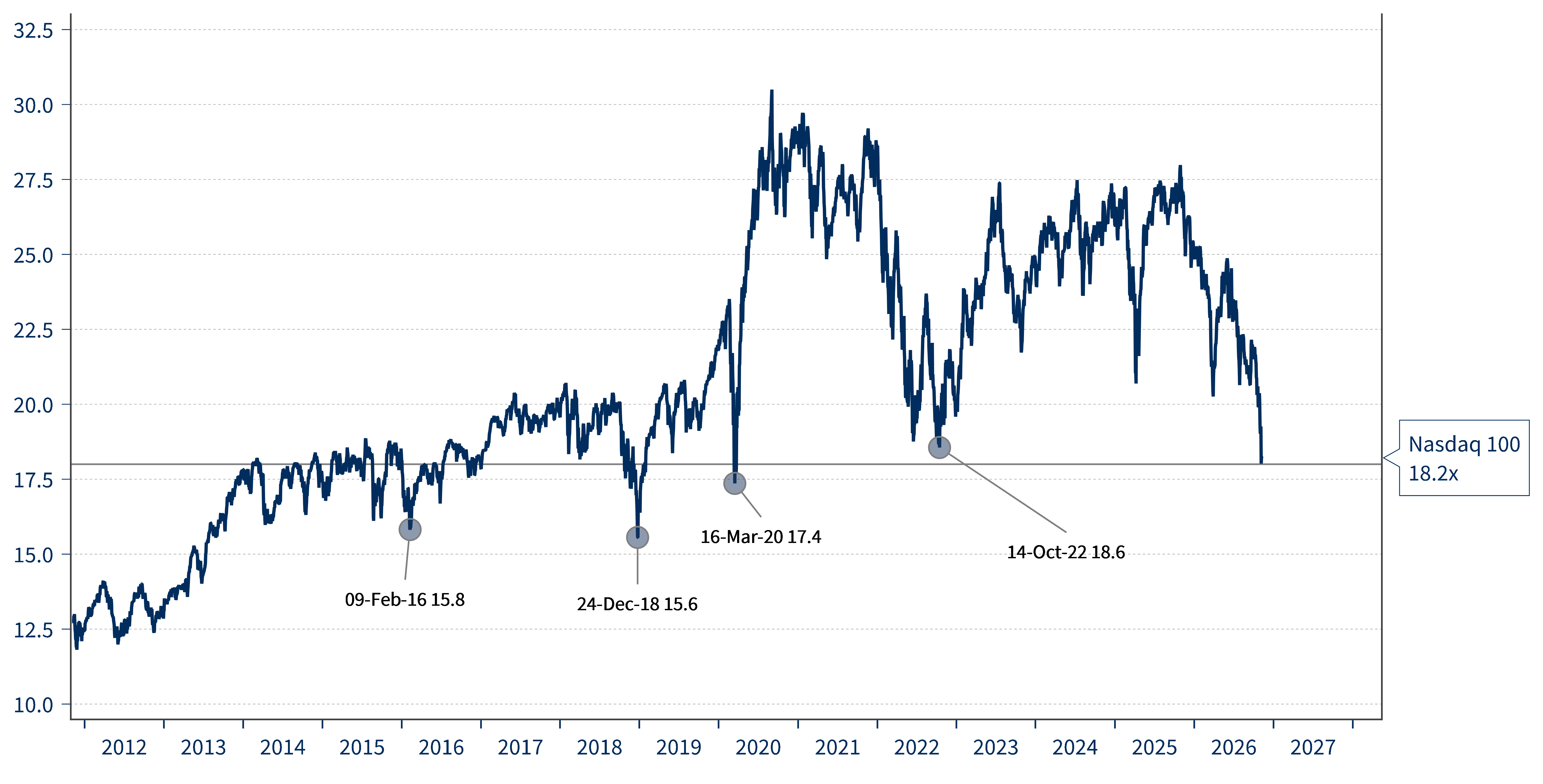
Some perspectives on the Tech correction: Since the peak in early October, Nasdaq is down almost 14%. Historically, such drawdowns are an opportunity, and in our view, this time is no exception. In a context where earnings expectations continue to be revised up, valuations have become very attractive. On a 12-month forward P/E basis, the Nasdaq valuation is now back to levels last seen in 2020 (COVID) and 2022, during the great interest rate normalisation phase.
Political and regulatory risk is back, however, and sentiment remains fragile after the post-midterms Tech rout. Three important states in terms of data centre development (Texas, Ohio, and Georgia) elected Democratic governors, representing major Republican-to-Democratic flips. Texas in particular is a major destination for AI infrastructure development, and the newly elected governor has promised a moratorium on new data-centre approvals.
However, cancellation risk is minimal for data centres already operational, low for projects under construction, and medium for projects approved but not yet started. Projects facing cancellation risk can, however, be relocated. Republican-led states such as Indiana, Tennessee, Louisiana and Wyoming could end up benefiting from that.
Diversification matters: Although we believe the Tech correction is creating opportunities, we acknowledge that political and regulatory uncertainty could take time to dissipate. Given the high concentration of equity indices, the importance of data-centre-related capex to US economic growth, and the exposure of other sectors, including electrical equipment, metals and mining, and utilities, to the AI ecosystem, we have advocated diversification into small caps, telecommunications and health care. The latter has experienced a sharp rally that now looks overextended, however, and could underperform if risk sentiment improves.
CHART OF THE WEEK
The Nasdaq valuation is back to levels last seen during the great interest rate normalisation of 2022 (12-month forward P/E ratio)