After two consecutive months in the red, November is shaping up to be another challenging month for equity markets, with the MSCI World down 8% MTD in USD. Investor confidence is being undermined by several factors: the lack of progress toward resolving the Middle East conflict; the prospect of further central bank rate hikes as inflation remains well above target; and interconnected risks across the AI ecosystem, compounded by concerns that a Democratic-controlled Congress could push for tighter restrictions, or even a moratorium on new data-centre developments. Our asset allocation has remained unchanged, meaning that we have absorbed the downside but remain positioned to benefit from a rebound. We believe the selloff has gone too far in light of resilient economic activity, strong earnings growth, and increasingly attractive valuations.
What would it take to restore market confidence? ETF flows and CFTC positioning data suggest that investors continue to see opportunities in Tech. We had expected Nvidia's strong earnings beat and Anthropic's successful IPO to lift market sentiment and provide a catalyst for attractive valuations to be reflected in share prices. Yet neither of these critical milestones managed to reverse the downward trend, as the investigation involving Nvidia and tighter chip export controls have remained sources of uncertainty. Below, we outline the potential catalysts that we believe could turn sentiment around in the coming weeks.
#1: Stronger-than-expected AI adoption figures. OpenAI regularly reports its weekly active users, which have increased from 800 million a year ago to 1.2 billion in September 2026 (+50% YOY). Strong figures for October and November could help restore confidence, given OpenAI's 56% share of AI chatbot web visits. Enterprise revenue growth remains another source of uncertainty for the AI trade, and evidence of continued rapid expansion would undoubtedly be welcomed. Recent research from MIT (link) suggests that open-source models face monetization challenges and struggle to attract enterprise spending due to safety concerns, lower reliability in complex tasks, and limited tool integration. According to another recent report (link), frontier AI labs now account for 69% of enterprise AI deployments, up from 50% a year ago. Anthropic's share of enterprise API spending has increased from 40% to 55%, OpenAI's has risen from 27% to 31%, while Google's has fallen from 21% to 9%. Open-source models account for just 4% of spending despite representing 19% of usage. Overall, enterprise AI spending has surged from $33 bn to $177 bn in just one year, a 5.4-fold increase.
#2: Progress in Middle East negotiations could drive oil prices down towards $80/b and ease interest rate expectations. The Fed is highly likely to raise rates again following last month's acceleration in inflation. That said, spot oil prices have fallen by 20–25% so far this month, refining margins are collapsing, and retail fuel prices are following suit. These developments should become visible in the November CPI report, due on 10 December, one day after the FOMC meeting.
#3: A softer stance from newly elected Democrats on data-centre development. Texas is under particular scrutiny, as around 30% of planned US data-centre capacity is estimated to be located there. Recent policy developments have heightened uncertainty around the sector. While Texas regulators have resumed reviewing data-centre applications, political debate around the environmental and energy impacts of large-scale data centres remains intense. Gina Hinojosa, who is set to become Governor in January, has advocated a temporary pause in data-centre development to allow for the establishment of a clearer regulatory framework. Any signs of a more pragmatic approach from Democratic policymakers could help alleviate concerns surrounding future AI infrastructure deployment.
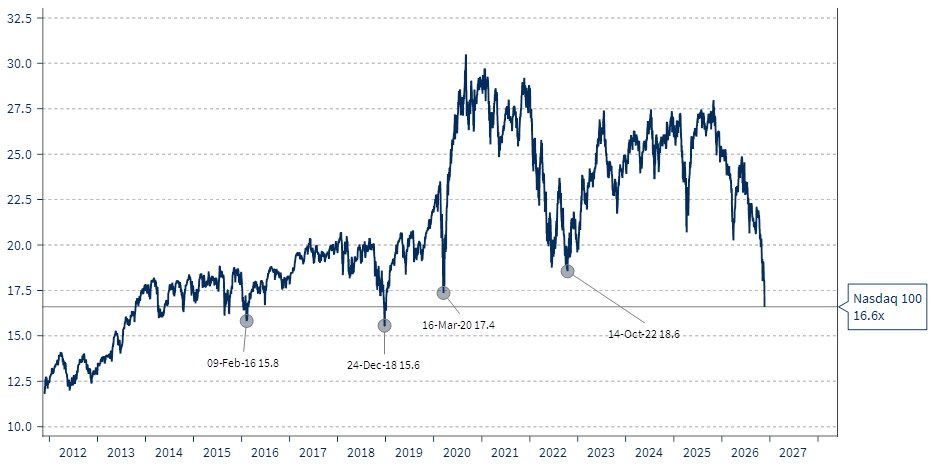
#4: Attractive valuations could attract dip buyers, provided earnings expectations hold up. The Nasdaq 100 has fallen 20% from its early-October peak, while the S&P 500 is down 12%. The Nasdaq's 12-month forward P/E ratio currently stands at 16.6x, below the trough reached in October 2022 (18.6x) and the low recorded during the Covid selloff in 2020 (17.4x), both of which were followed by sharp market rebounds. Admittedly, interest rates in 2020 were significantly lower than they are today. However, the combination of equity valuations and interest-rate levels was more comparable in 2022, suggesting that current valuations may already reflect a substantial degree of caution.
Some investment ideas beyond the AI trade.
Renewable energy. Following the midterm elections, Democrats are expected to continue promoting clean-energy investment through financial incentives and industrial policy, although presidential veto powers may limit the scope for legislative change. The sector remains sensitive to interest rates, but we believe this could gradually become a tailwind.
European renewable-energy companies with significant US exposure and a Buy recommendation from Kepler analysts include EDPR, Ørsted and Vestas Wind Systems. More broadly, Nexans and Prysmian are key beneficiaries of the electrification and grid-investment theme. Iberdrola is another way to gain exposure to this theme (Hold).
Cybersecurity has become a critical global priority. Cyberattacks have increased significantly in recent months, while advances in AI have made attacks faster, more scalable and harder to detect. According to the World Economic Forum, organisations are increasingly shifting to proactive security strategies, a trend that should continue to support demand for cybersecurity solutions. Cybersecurity remains predominantly a US investment theme, with relatively few European-listed companies exceeding a €1bn market capitalisation. CrowdStrike, Palo Alto Networks and Gen Digital are rated Buy by our US research partner, Argus Research. Fortinet, although not covered, is also a major player in the sector.
CHART OF THE WEEK
Nasdaq 100 12-Month Forward P/E Ratio: valuation is back to levels last seen during the COVID trough in 2020