
As far as the markets are concerned, both Klaas Knot and Pablo Hernández de Cos have strong credentials. It is, however, reasonable to assume that the Spaniard would be more interventionist than the Dutchman.
From darkness to light. Central banks have traditionally operated away from the political spotlight. Their core mandate is to conduct monetary policy by setting interest rates in line with inflation objectives and underlying economic fundamentals, including growth, fiscal balances and external competitiveness. Their remit is primarily technical rather than political. They also play a critical role in banking supervision and in coordinating with financial market regulators.
Yet the role of central banks has evolved markedly since the 2008 financial crisis, and it is against this backdrop that the succession race at the ECB takes on particular significance. As guardians of financial stability, central bankers have become increasingly influential participants in economic debates. The deployment of central bank balance sheets, theoretically unconstrained, to purchase debt securities and support financial markets has fuelled intense controversy that continues to this day. The current Chair of the Federal Reserve, Kevin Warsh, has charted a different course from that of the past decade, advocating less market intervention, a retreat from forward guidance and a reassessment of the tools and data underpinning monetary policy decisions.
Central banks have consequently become more political institutions. They are now expected to engage with issues such as climate change, while debates over their remit have increasingly entered the political arena. In France, for example, questions surrounding the role of central banks have become part of the presidential campaign. Likewise, the fragmentation of the global economic order since the Trump era, the rise of populism and growing concerns over public debt sustainability are issues on which the next ECB president may be expected not only to express a view but also, potentially, to act.
Two candidates are in the running: Klaas Knot and Pablo Hernández de Cos. The former, a Dutch national, is seen as more hawkish than the latter, a Spaniard, who is regarded by the markets as more dovish. Two other key posts are up for appointment: the post of chief economist and the replacement for Isabel Schnabel, a member of the Executive Board and the Governing Council. Spain is backing Pablo Hernández de Cos, whilst France also appears to favour his candidacy. The Germans are positioning themselves for the post of chief economist and the French for the vacancy to replace Isabel Schnabel. A reshuffle is on the cards, and negotiations have intensified since the announcement of Christine Lagarde’s early departure, scheduled for next February.
What are the implications for the markets?
Whilst both candidates have strong credentials, it seems likely that the Spanish candidate would take a more interventionist approach than the Dutch candidate, even though the latter has recently indicated that he is in favour of using the available instruments to manage a debt crisis should one arise. Expectations for key interest rates would likely be revised downwards if Pablo Hernández de Cos’s candidacy were to become the most likely outcome, as we believe it will. No Spaniard has ever held the post of ECB President since its creation, even though Spain has led the way in terms of reforms and growth in recent years. The Netherlands, by contrast, has already had Wim Duisenberg at the helm of the ECB; France has had Jean-Claude Trichet and Christine Lagarde; and Italy has had Mario Draghi.
However, we must not be mistaken. Pablo Hernández de Cos is seen as more dovish than Klaas Knot, which could weigh on the euro in the short term. But the former Governor of the Bank of Spain has long been an advocate of fiscal consolidation and structural reforms. As head of the Bank for International Settlements, he has followed the tradition of monetary orthodoxy. We should therefore expect continuity rather than a break with the past, which is probably one of the implicit objectives of this transition: to avoid causing market turbulence. Decisions at the ECB are taken collectively, and the other two appointments will also help shape the direction of the ECB’s Executive Board. The real difference may become apparent in the event of a major crisis. In our view, Hernández de Cos would be more inclined than Klaas Knot to resort to unconventional instruments to preserve financial stability. This is a rather reassuring prospect for the future of the euro.
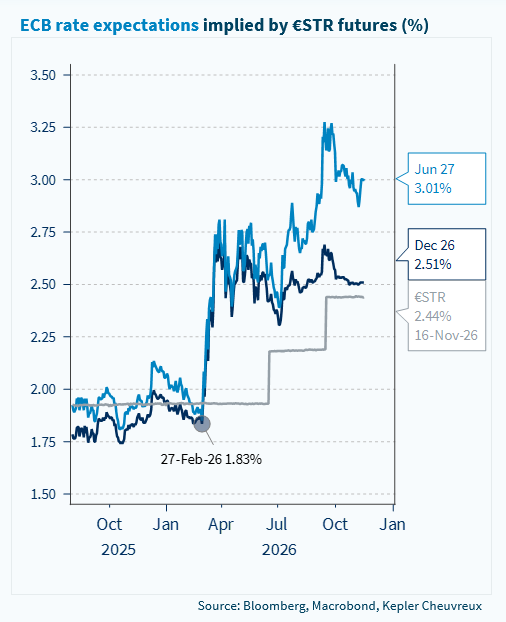
CHART OF THE WEEK
Rate expectations have moderated, but the path ahead still points higher