
Election Day in the US is upon us and may mark the beginning of an important political shift. Betting markets and opinion polls point to a high probability of a Democratic sweep. However, investors should treat such signals with caution. Pollsters and prediction markets have misread several major political events in recent years, including Brexit, the 2016 US presidential election, the 2022 US midterms, and, more recently, elections in Brazil and Israel. Consequently, we would avoid taking overly aggressive positions based solely on current polling and market-implied probabilities.
If the consensus view proves correct, we would expect renewable energy, healthcare services and homebuilders to emerge as relative beneficiaries. By contrast, traditional energy, defence, and selected areas of the pharmaceutical and banking sectors could face increased regulatory and policy headwinds.
The Technology sell-off intensified last week, with hyperscalers, digital platforms and cybersecurity stocks experiencing particularly sharp declines. Investors remain focused on AI adoption and monetisation, increasingly demanding tangible evidence that the massive wave of data-centre investment will ultimately generate attractive returns. Despite the adverse price momentum, Nasdaq earnings revisions continue to trend higher, while medium-term valuations have become increasingly compelling. The market is placing significant weight on declining free cash flow yields, a metric that has historically been a poor predictor of Technology sector performance. We therefore maintain a constructive stance on the sector, even if convincing evidence of AI-related returns may take time to emerge.
On the macro front, the latest quarterly economic releases, together with corporate earnings reports, continue to portray an economy growing at a healthy pace. In the US, activity remains remarkably resilient, with real GDP expanding by 3.4% in Q3 and nominal GDP by 5.6%. Personal consumption and private capital expenditure were the main growth drivers, complemented by an inventory build-up. In the euro area, the narrative of growth resilience received further confirmation from recent data releases.
Corporate profits are also proving exceptionally strong, though in line with expectations in the US. With the Q3 earnings season now more than halfway complete in both Europe and the US, EPS growth for the S&P 500 and the Stoxx Europe 600 is running at approximately 25-30% year-on-year versus Q3 2025. Yet equity markets have been relatively reluctant to reward these results. Investors appear increasingly concerned that robust economic growth may sustain inflationary pressures, while geopolitical tensions and commodity-price risks remain elevated.
Heading towards a settlement in the Middle East? Over the weekend, media reports highlighted the risk of further escalation in the Middle East, as both the US and Iran appeared to adopt tougher negotiating positions in an effort to strengthen their bargaining power. We believe, however, that both sides are under growing pressure to reach a settlement. As a result, the probability of a deal has increased, raising the prospect of another round of sector rotation and factor reversals across equity markets.
A higher likelihood of a US-Iran agreement would likely weigh on energy prices while supporting a rebound in some of the most depressed consumer discretionary segments. Real Estate could also benefit if easing inflation expectations contribute to lower bond yields.
How to diversify portfolios? While we are not advocating reducing Technology exposure following the Nasdaq's 10% correction, we believe investors should increasingly focus on diversification, as convincing evidence of AI-related returns may take longer to emerge than the market initially anticipated.
European Small Caps continue to benefit from supportive growth conditions and could receive an additional boost should inflation and interest-rate expectations moderate. Their valuation discount relative to European large caps remains historically attractive.
European Telecoms offer an appealing combination of defensive characteristics, attractive dividend yields, and exposure to the European consolidation theme. Europe remains one of the most active regions globally for M&A, and our analysts see particularly strong consolidation potential within the telecom sector.
Healthcare remains one of the sectors least exposed to the AI infrastructure investment cycle, providing valuable diversification. The sector has recently delivered significant earnings surprises in the US and could also selectively benefit from a Democratic sweep. We favour a balanced US-Europe allocation.
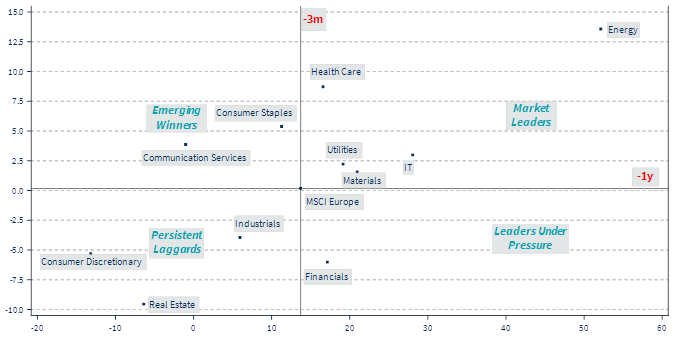
Is it time to revisit European Luxury? Our analysis suggests that a meaningful easing in geopolitical tensions could trigger a significant reversal between Energy and Consumer Discretionary stocks in Europe, with the former potentially underperforming and the latter outperforming. While recent earnings releases have undoubtedly been challenging, we believe the underperformance of the luxury sector has become excessive. A more favourable geopolitical backdrop, combined with lower energy prices and improved consumer purchasing power, could provide a more supportive environment for the sector than is currently reflected in market pricing.
CHART OF THE WEEK
The recent winners and losers could see sharp rotations if commodity prices ease