
KEY TAKEAWAYS
➔ Higher interest rates and concerns over AI monetisation have triggered a sharp correction in technology stocks.
➔ Gartner estimates that asset impairments across AI infrastructure could reach $3.5 trillion by 2030.
➔ AI adoption remains strong, with ChatGPT reaching 1.2 billion weekly active users in September 2026.
➔ Advertising, paid subscriptions and a potential decline in interest rates could support industry profitability.
➔ Diversification remains essential, and we continue to favour hyperscalers over semiconductor stocks.
US midterm elections are fast approaching, and Trump's congressional majority is coming under increasing pressure in the polls. The US administration has explored various ways to lower fuel prices, including controversial arrangements involving Russia, but none appears to be a genuine game changer. The only potential catalyst for a meaningful decline in commodity prices would be a deal with Iran. In our view, a Democratic sweep could help push bond yields lower, as political gridlock would likely impose a degree of fiscal restraint, but it will not change the picture dramatically.
Higher-for-longer interest rates are reverberating across global equity and bond markets. France's interest expense was already expected to rise significantly before the latest market moves, which are placing additional pressure on fiscal balances. At the end of this report, we revisit our three scenarios for the OAT-Bund spread, with our base case remaining a move back towards 100-120bp from around 150bp currently. However, the primary focus of this report is the AI trade, which has also come under pressure as higher yields raise the required return on investment.
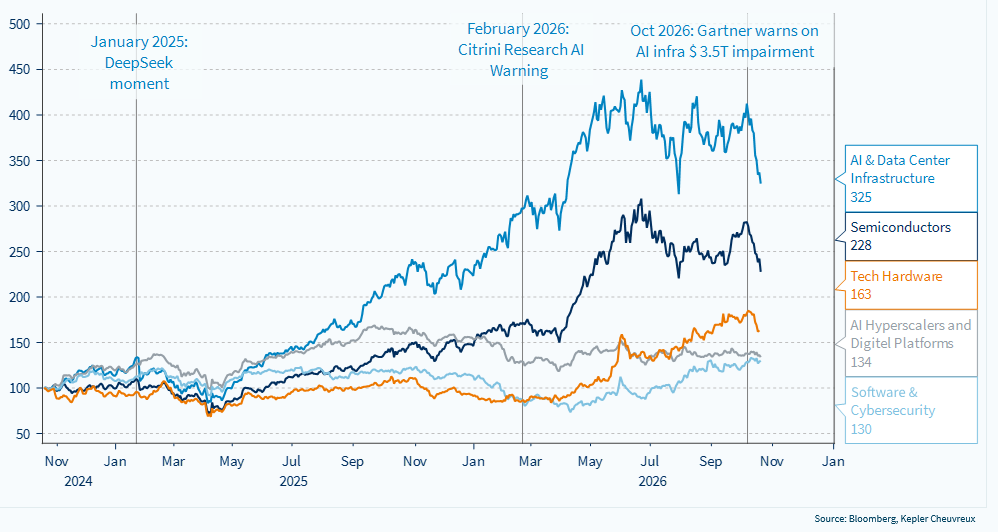
A wave of panic swept through the technology sector last week, triggering sharp declines in a number of stocks across the United States, Europe and Asia. The combination of higher-than-expected US inflation, which pushed interest-rate expectations higher, and the publication of bearish research reports on technology hardware companies and data-centre operators created a powerful squeeze effect. If corporate adoption of AI falls short of expectations, revenues may prove insufficient to service the debt incurred to finance massive investments. Ultimately, two variables matter most: the pace of AI adoption and the cost of capital.
Another research report, this time from consulting firm Gartner, estimates that asset impairments across the AI infrastructure segment could reach $3.5tn by 2030 if technology companies continue investing at their current pace without generating revenues commensurate with these capital expenditures. Yet other AI consultants offer a more nuanced view, arguing that 2027 will be a pivotal year, as the industry transitions from a phase of large-scale infrastructure buildout to one focused on monetization.
The available indicators on AI adoption remain broadly reassuring. ChatGPT reached one billion monthly active users in June 2026 and 1.2 billion weekly active users in September. Meta AI and Google Gemini have also crossed the threshold of one billion monthly users. ChatGPT remains the market leader, accounting for 56% of AI chatbot web traffic in September 2026.
According to OpenAI, its conversion rate, defined as the proportion of users upgrading from the free version to a paid subscription, stands at around 5-6%. While this may seem modest, it translates into approximately 50-60 mn subscribers paying an average of $20 per month, equivalent to roughly $15-18 bn in annual recurring revenue. Enterprise revenues come on top of this, bringing OpenAI's annualized revenue run rate close to €50 billion according to the latest estimates. Meanwhile, Anthropic is estimated to generate more than $60 bn in annual revenue and may already be profitable.
Risks and opportunities on a monumental scale. Artificial intelligence clearly represents a powerful source of opportunity. The OECD, for example, estimates that AI could boost annual labour productivity growth by between 0.4 and 1.3 percentage points in highly exposed economies. At the same time, the IMF has warned of potential systemic risks should expectations fail to materialize, given the sector's substantial leverage, the interdependencies among market participants, including forms of circular financing, and the possibility of global contagion through international investors' exposure to US assets.
What conclusions should investors draw? First, we do not believe that interest rates will remain at their current levels indefinitely. AI-related investments are highly sensitive to geopolitical tensions through their impact on interest rates, since higher rates increase the required return on capital expenditure. Lower rates would help alleviate pressure on the industry.
Second, AI companies have several levers at their disposal to increase revenues. Advertising has begun to emerge as a meaningful source of monetization. OpenAI's advertising pilot reportedly reached an annualized revenue run-rate of approximately $100 million shortly after launch. In addition, conversion rates could rise rapidly if limitations are imposed on free users. Subscription prices may also increase over time.
From an investment perspective, diversification remains key within the technology theme. Industry dynamics are evolving rapidly, and the figures reported at the start of the year could be substantially higher by 2027. Nevertheless, the risks should not be underestimated given the scale of capital commitments and the complex web of interdependencies that has developed across the ecosystem.
It is also worth remembering that the AI infrastructure stocks targeted by the recent sell-off represent only around 2.5% to 3.5% of the S&P 500 and roughly 4% to 6% of the Nasdaq. Meanwhile, hyperscalers such as Amazon, Meta, Microsoft and Alphabet possess considerably stronger balance sheets, more diversified revenue streams and far greater financial resilience. Consequently, we continue to favour hyperscalers over semiconductor stocks within the AI investment theme.
CHART OF THE WEEK
Is this time different? AI remains vulnerable to profit-taking as investment races ahead of monetization (Kepler Cheuvreux equal-weight AI thematic baskets, rebased)