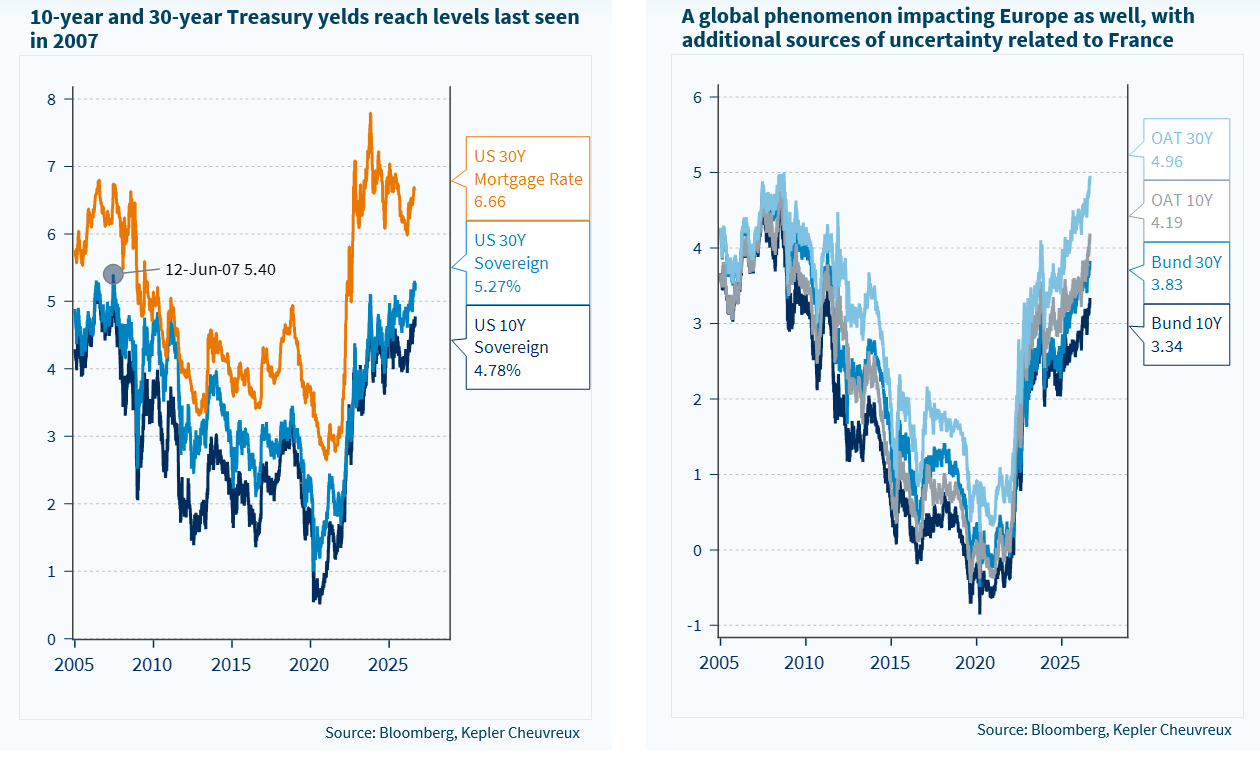

In this report, we analyse the factors that drove bond yields sharply higher over the summer and assess which of these may reverse. This is the second instalment of our year-end outlook, focusing on rates. Last week, we outlined our preferred equity sectors and investment themes.
Rates caught in the crossfire. The near-term outlook for rates remains heavily influenced by geopolitical developments. Persistently elevated energy prices could generate second-round effects across food, goods and services inflation, potentially forcing central banks to keep rates higher for longer. We view a Brent price range of USD 90-100/bbl as challenging for central banks, with a sustained move above USD 100/bbl posing an even greater policy dilemma.
The latest euro area CPI release showed headline inflation accelerating to 3.3% in August from 2.9% in July, while core inflation remained unchanged at 2.5%. In our view, this all but guarantees that the ECB will raise rates to 2.5% at its 10 September policy meeting. However, this move is already largely priced in, with 3-month Euribor trading around 2.6%.
Following the Fed Chair's speech at Jackson Hole last week, a 25bp rate hike at the 16 September FOMC meeting also appears increasingly likely. Early signs suggest that the recent energy shock is beginning to filter through to underlying inflation, raising the risk that the disinflation process could stall in the months ahead.
The key question is whether this marks the start of a new tightening cycle or merely a one-off adjustment. Markets are pricing in a second ECB rate hike by early 2027. By contrast, we expect the ECB to remain on hold at 2.5% throughout 2027 following the September move. This scenario assumes a moderation in commodity prices, however. We view the likelihood of a repeat of the 2022-23 inflation shock, which pushed the ECB deposit rate to 4%, as low. In the US, markets are also pricing in roughly two rate hikes over the next six months, whereas we expect only one hike this autumn.
Other factors have also contributed to the rise in bond yields and are likely to remain in place.
These include the resilience of global economic activity, substantial financing needs associated with the AI investment cycle, a deteriorating fiscal outlook, and heightened monetary policy uncertainty under the new FOMC Chair, Kevin Warsh. We do not expect any of these factors to reverse in the near term. However, a slowdown in growth or a scaling back of hyperscalers' capex plans could alter the outlook.
What could help ease the pressure on bond yields?
Betting on geopolitical outcomes is speculative. That said, the conflict in the Middle East remains unpopular in the US, which may act as a constraint on further escalation. On the Iranian side, reports over the summer highlighted a “near economic collapse”, with inflation approaching 100% and the currency remaining under severe strain. Could these factors ultimately encourage both sides to make concessions and facilitate the reopening of the Strait of Hormuz? It is possible, and such an outcome would likely provide meaningful relief to energy markets and bond yields alike. However, at this stage, it remains a high-conviction risk rather than a base-case scenario.
The "Bessent put" refers to larger Treasury buybacks of off-the-run long-dated securities, financed using available cash balances. There is evidence that measures aimed at influencing the long end of the yield curve can have meaningful market effects, making them akin to a form of quasi-monetary policy.
Conclusion: We expect rates to stay higher for longer, but in developed markets, any form of sovereign default or debt restructuring remains highly unlikely in the medium term. While fiscal deficits and debt trajectories are a growing concern, sovereign CDS markets are not signalling an increase in credit risk. Assuming commodity prices moderate, bond yields should gradually ease, and the "Bessent put" could help limit further upward pressure on long-term yields. Against this backdrop, we favour the 3-7 year segment of the yield curve at present, which offers an attractive balance of carry and duration risk. Within European government bonds, we prefer Spain and Italy to France, reflecting rising concerns over France's fiscal outlook amid difficult budget negotiations and ahead of the 2027 presidential election cycle.
CHART OF THE WEEK
Long-term yields keep rising, driven by geopolitics & inflation risks, growth resilience, fiscal & monetary uncertainty