
Recent price action across asset classes shows that geopolitical uncertainty continues to cap investor sentiment despite robust earnings growth projected into 2027. While conflict de-escalation remains elusive, Brent crude prices hovering in the $95-100/bbl range are a source of concern. Nevertheless, we continue to prefer equities over bonds in a context of higher inflation, which, on top of the commodity shock, is also related to buoyant growth conditions. We expect Trump to keep tensions with Iran from escalating materially ahead of the US midterm elections. But these days, we acknowledge that betting on geopolitics is like flipping a coin.
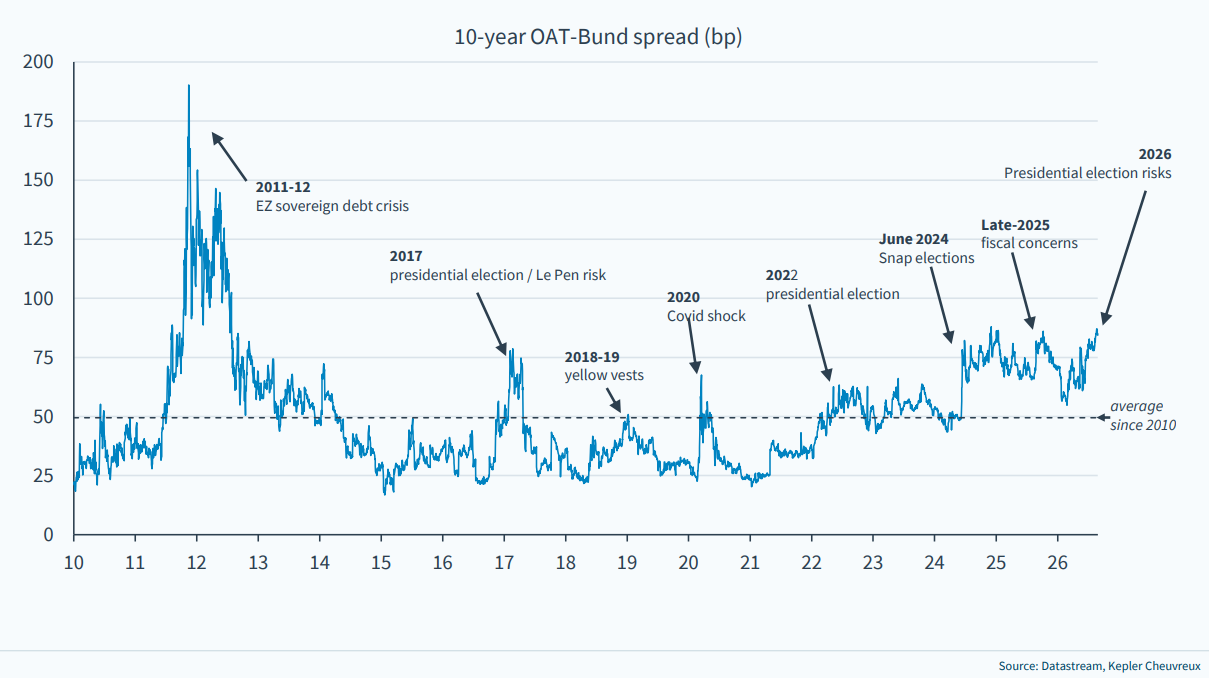
France in the spotlight. We turn our attention to France, where investors are demanding a higher risk premium amid persistent political uncertainty. As we approach critical milestones (budget negotiations, presidential and likely legislative elections), the OAT-Bund spread has widened, with negative implications for French equities. For instance, French banks trade at a discount versus European peers due to political risks. This note is the first instalment of our work on the French presidential election. We will continue to monitor developments and publish further updates in the coming months.
As discussed in the report, current polling suggests that Marine Le Pen (RN, far right) is well-positioned to win the presidential election. The party has no experience in national government and continues to hold an ambiguous stance on key issues such as pension reform and fiscal discipline, raising concerns among investors. Polls also indicate that the RN would be unlikely to secure an outright parliamentary majority and would therefore need to build coalitions. By contrast, the right wing of the centre-right remains the only credible alternative, with a fiscal agenda that is considerably more market-friendly. In our view, this represents the main upside risk to the current market narrative. However, it appears premature to position portfolios for such an outcome at this stage.
We expect the OAT-Bund spread to stay higher for longer, but any form of sovereign default or debt restructuring remains highly unlikely. While fiscal deficits and debt trajectories are a growing concern, public debt sustainability in France is not an issue for now. Within European government bonds, we prefer Spain and Italy to France in the near term, but also believe that OATs might later represent an opportunity.
On a positive note, France’s private sector has a strong financial position and provides a significant source of funding for the government. This reduces the country's reliance on external financing, although non-residents still hold 56% of outstanding government debt. France’s aggregate balance sheet (public and private sector) differs markedly from those of Spain and Greece in the run-up to the sovereign debt crisis of 2010-12.
CHART OF THE WEEK
The bond market shows a clear risk premium for France